
Most companies are aligned to one cloud so, other than Gartner, it's hard to get a true cross-cloud read. We're one of the few organisations that are truly cloud agnostic and have delivered agentic AI solutions across GCP, AWS and Azure. The question of which cloud is a common one in our work, here's what I say to clients when the topic comes up.
Firstly, agentic AI is both workspace individual agents and enterprise agentic AI solutions. The individual can do tasks faster with agentic AI, the organisation can gain productivity improvements by building the roads for agents (see Agents at the speed of a horse). We should consider both when thinking about clouds.
Microsoft leads workspace. AWS leads general cloud on scale and breadth, but on the AI and data infrastructure that agentic work depends on, Google is ahead, with AWS close behind. Google challenges on workspace too. Most organisations are now considering multi-cloud, largely driven by a realisation that Azure is behind on AI and data. The most common conversation is with customers already using Microsoft workspace and Azure, that want to add a second cloud into their stable. There's a choice between AWS and GCP to make, with AWS tending to win where there are governance or developer requirements that lean towards it and GCP tending to win for the latest AI and ease of use, particularly via UI and IAM. AWS leverage their partner network with GCP leaning direct but growing their partner involvement. The differences between GCP and AWS are however small, and commercials tend to win the overall argument.
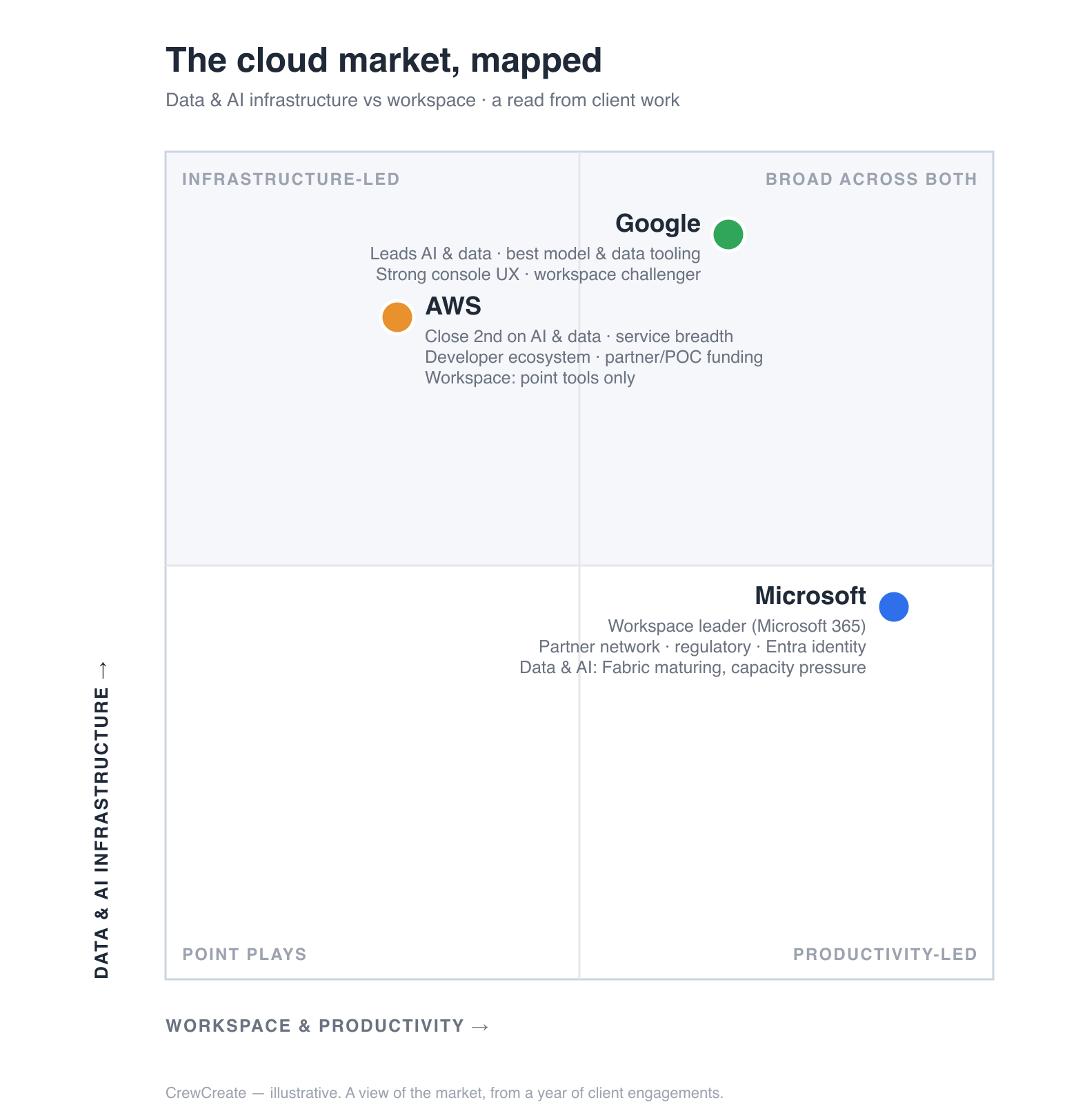
Above is my view on the cloud x workspace positioning of the 3 hyperscalers. Gartner's June 2026 Magic Quadrant for Cloud AI Infrastructure reads the same way. In the leaders' quadrant, Google and Amazon Web Services sit furthest up and to the right on ability to execute, with Microsoft a clear step behind them. That is not a knock on Microsoft as an enterprise platform, where it is dominant. It is a specific statement about AI infrastructure, and it matches what I see when the workload in question is machine learning, data engineering or agentic AI. The full quadrant is worth reading in Gartner's own words; I have linked the reprint below.1
What triggers a Microsoft customer to explore a second cloud?
Three frictions come up again and again with customers who are Azure-only and trying to build something genuinely AI-heavy on top.
The first is tooling maturity. For example, we're working with a large publisher whose entire analytics estate is on Fabric. They are capacity limited by Fabric SKUs (compared to truly elastic compute on GCP/AWS) - either paying for unused compute or hitting the limits, never the right amount. Fabric is a less mature analytics solution with pipeline orchestration being driven by scheduled notebooks. This unfortunately creates hard to govern JSON spaghetti. The one standout product, Power BI, is fragile due to the underlying data governance.
The second friction is capacity. At a regulated advisory firm this year, the blocker to consolidating AI onto Azure was not philosophy, it was physics: at the time, UK-region GPU-class compute was booked weeks deep, which is a poor home for net-new AI workloads, and Azure GPU scarcity has not been a UK-only story. Capacity constraints move around and improve, so I would not lean a strategy on them. But they are a real, recurring reason that the AI workload ends up somewhere other than the incumbent cloud.
The third friction is operability, and it's the one agents and developers feel the most. AWS and Google are, at heart, API-first: almost everything is headless, scriptable, reproducible through infrastructure-as-code and easy to wire into a pipeline or be read by an AI agent. Azure is largely the same, but too often its newest surfaces are click-ops only. This matters more than it sounds, as development is slower by the human time to resolve console blockers. This is the mud road I wrote about in Agents at the speed of a horse: the capability underneath can be world-class, but if the only road to it is manual clicking, you move at the speed of a person clicking.
Why a second cloud and not migration?
Almost nobody rips out Microsoft or Azure. The history and habits are too embedded, there is tangible lock in. Microsoft stays for identity, email and collaboration as it is generally strong and deeply embedded there. What changes is that the new value, the AI and data workloads, goes to a second cloud chosen for that job.
This is the multi-cloud form of a point from Roads, bridges and the traffic that never existed: the value is rarely in re-hosting the journeys you already make, it is in the new ones a better platform opens up. You do not move the old estate for its own sake. You put the new, higher-value AI and data workloads where they run best, and leave the rest where it already works.
A UK financial software provider we worked with is the clean example. Its entire product estate ran on Microsoft and Azure, and as it pushed into AI-assisted products the economics and capacity started to strain enough that a migration assessment put a seven-figure annual saving on the table for moving to a second cloud.
A global corporate-services firm did the same thing from the AI direction. A Microsoft shop to its core, running Entra for identity and an Azure-hosted model pipeline for its existing regulatory monitoring, it chose to build its next-generation AI platform on AWS with Claude underneath, drawn by a strong reference deployment and partner funding. The legacy platform stayed on Azure. The new AI workload went to AWS. Two clouds, on purpose.
How to choose your second cloud
If you are a Microsoft customer feeling the pull, here is the approach I would take.
Keep Microsoft where it is strong. Identity, productivity and the line-of-business estate should stay on Azure and Entra. You are adding a cloud, not replacing one.
Put the second cloud where the new value is. If your bet is regulated, enterprise software build with a broad service catalogue, lean AWS. If your bet is AI and data capability, lean Google. Then let commercials break the tie, because with partner funding in the mix the tie gets broken there more often than not.
Keep the AI layer swappable. Put model inference behind a provider abstraction so you can route each workload to the best-value model that meets your data-residency and quality bars, and so today's price-driven choice is not tomorrow's lock-in.
Invest in the seam first. Federate identity from Entra into the new cloud before you move a single workload, and decide who owns cross-cloud identity, data movement and lifecycle. That team is your multi-cloud strategy, more than any architecture diagram.
The short version
- No single cloud leads on everything. Microsoft owns workspace; Google leads AI and data infrastructure with AWS close behind; Azure is the one falling behind on AI and data.
- Microsoft customers aren't replatforming. They keep Azure and Entra for identity and productivity, and add a second cloud for the AI and data workloads.
- Three frictions push Azure-only teams to a second cloud: Fabric's tooling immaturity, GPU capacity scarcity, and Azure's occasional click-ops-only surfaces where AWS and Google are API-first.
- The AWS-versus-Google choice is narrow: AWS leans governance, developer experience and partner network; Google leans the latest AI, UX and IAM. Commercials usually break the tie.
- Keep the AI layer swappable behind a provider abstraction, so today's price-driven model choice isn't tomorrow's lock-in.
- The real multi-cloud work is at the seam: federate identity from Entra into the new cloud first, and name who owns cross-cloud identity, data movement and lifecycle.
Footnotes
-
Gartner, Magic Quadrant for Cloud AI Infrastructure, June 2026. Read the full report via Gartner's reprint: https://www.gartner.com/doc/reprints?id=1-2NMT0142&ct=260630&st=sb. Gartner does not endorse any vendor, product or service depicted in its research and does not advise technology users to select only the highest-rated vendors; the quadrant reflects the analysts' opinion at a point in time. This piece is my own reading of the market and my own client experience, not a Gartner publication. ↩