
Cars were invented around 1900, but the first road built just for them, in Germany, didn't open until 1932, and Britain's first motorway not until 1959.1 For roughly half a century the car was capable of far more than the world around it could use. I think agentic AI is at the start of exactly that gap, and watching it open has been the most striking thing I've seen in my career.
This year, building agentic solutions across industries and company sizes, we've watched two-person organisations use agentic coding to create millions of pounds of value in a matter of months. We've also watched larger companies invest millions and see almost nothing. The capability of the agent is rarely the difference. For our own work agents are the default way we deliver, and when the conditions are right the gains are transformational. But those conditions turn out to be mostly about the organisation, not the model.
AI was useful before agents: a daily support, a feature baked into products and services. But in the last six months the capability has crossed a line: whole categories of work can now be automated, not just assisted. Software engineering has felt this first and hardest, but the same is already true of almost any process that mostly lives in documents. Across financial, legal, industrial, education and publishing clients we keep seeing the same thing: the same agent that transforms one person's output can, dropped into an unchanged system, become a net drain on the organisation's.
That gap is what sent me looking backwards for a precedent. The usual one offered is the electrification of factories; for me the story of the car is more useful, and more uncomfortable. Even if every horse owner in 1900 had been handed a car overnight, the mud roads, the missing fuel stations and the rules written for horses would have stopped them getting much value from it. AI's digital nature means it diffuses far faster than the car ever could. But the missing infrastructure around it is the same trap. What follows is what the horse-to-car transition can teach us about turning AI capability into economic benefit.
Unlocking speed and value
Cars provide faster, cheaper and safer transport than horses. Agentic AI is faster and cheaper and increasingly safer than human intelligence. Cars clearly transformed productivity and society, AI has yet to clearly show up as an economic growth driver. So what's missing?
In early 1900, when the car was first invented, the world was built for horses. On the rutted mud and dust roads of the era, built for hooves and iron-rimmed wheels, a car couldn't reliably exceed the pace of a horse drawn carriage. It broke down, got stuck and had to have a human walking ahead with a red flag. The car was capable of far more; the system delivered a fraction of it.
Consider the above paragraph re-written for agentic AI:
In 2025, when agentic AI was first invented, the world was built for human intelligence. Within organisations built on rutted and patchy data and context, and built to manage people's social status and incentives, an agent couldn't reliably exceed the pace of a team of people. It broke, got stuck and had to have a human in the loop for every decision. The agent was capable of a lot more; the system delivered a fraction of it.
The parallel is uncanny. So how did car speed evolve from the era of horse transportation? Three different speeds need to be considered. There was what was technically possible: what the machine could do under ideal conditions. There's the speed achievable on a private road such as a test track. And there is the speed achievable on a public road; the ordinary network shared with everything else, governed by the law and road environment rather than by the car itself.
| Year | Possible (capability) | Private road | Public road (UK limit) |
|---|---|---|---|
| 1865 | Steam road locomotives | — | 4 mph rural, 2 mph town — plus a man walking ahead with a red flag |
| 1899 | ~65 mph — electric record car | Achères closed course — ~65 mph | 14 mph |
| 1907 | Climbing fast | Brooklands (a private racing circuit in Surrey, England) opens — Selwyn Edge averages 65.9 mph over 24 hours; built because the public limit blocked high-speed testing | 20 mph |
| 1910 | ~131 mph — Blitzen Benz, Daytona sand | Brooklands ~126 mph (Hémery, 1909); Daytona ~131 mph (Oldfield, 1910) | 20 mph |
| 1932 | — | First car-only, junction-free public road (Cologne–Bonn); horse-drawn carts banned — 120 km/h (~75 mph) | No general limit |
| 1959 | — | The M1 — Britain's first inter-urban motorway; no posted limit at opening | 30 mph built-up; no limit elsewhere |
| 1965 | — | Motorways carrying high-speed traffic — 70 mph | 70 mph — road and limit finally matched |
The speed capability and private road columns track each other closely. A controlled environment lets the driver push the car to its limits. The public road column stays low for six decades. In 1899 a purpose built car set a land speed record of 66 mph and by 1910 another ran 130 mph on sand.2 Across the same period a British driver on a public road was legally capped at 14, then 20 mph. Capability was never the bottleneck.
How does this map to agentic AI?
The public road rules were written for the previous technology. A person had to walk sixty yards ahead of a car waving a red flag. This is the parallel of policies that limit AI assistance and/or mandate 100% human in the loop. The system only tolerates human speed.
The law lagged so far behind capability that it became a dead letter. The 20 mph speed limit was so widely ignored it was abolished in 1930 — a contemporary said maintaining it brought the law into contempt.3 How many people are using "shadow AI" rather than company mandated approaches today?
Private infrastructure was built specifically to escape the public road ceiling. Brooklands (Surrey, England) is the cleanest case. Private capital funded 1500 workmen to build the world's first purpose built racetrack in nine months.4 In the agentic era, as well as private capital investing in compute, I see a parallel in AI native startups investing in new structures to support agent speed.
Over the years, car (or motorcycle) only roads with associated legal frameworks and social norms unlocked value. In Germany, the Cologne-Bonn road in 1932, in the UK the M1 in 1959, the American interstate in 1956. The motorway did more than enable speed, it triggered a reorganisation of where things are. The benefit came from new journeys and settlement patterns, not the same journey the horse would have made. Suburbs, logistic hubs, modern retail are all borne out of car travel. Sometimes the road even ran ahead of demand: the German autobahn was built before the country had enough cars to justify it. Road building was an enabling bet, not a response to congestion.5
How does this relate to similar productivity change from technology?
This is a common pattern repeated through history. AI is often referred to as a general purpose technology such as steam and electricity.6 Both transformed the production of physical goods, and displaced physical labour. A core finding of the literature associated with these changes is, counter-intuitively, initial adoption can decrease productivity before raising it. The time and investment required to build the complementary infrastructure and re-organise around it is a capital investment.
When factories first swapped steam for electric motors, they bolted the motors onto the old architecture. The machinery still clustered around a central driveshaft, because steam had demanded one. Electric motors removed that constraint, but for decades owners did not design around the new freedom and productivity barely moved. The leap came 40 years later when factories were rebuilt on the assumption of electricity.7
Many companies today are deciding to bolt on AI in an existing process. Retaining 100% HITL and human centered workflows and finding that productivity is declining with increased costs.8 To get the full benefit from AI, the whole system needs to change. Given both the ability to instantly access AI and the relative flexibility of the labour force compared to industrial machinery, this will come within a generation.
This reframes what an organisation should be optimising for right now. The instinct is to demand near-term profit or a productivity bump from every AI pilot, the equivalent of judging the first motorways by next quarter's traffic. But the autobahn was built ahead of the cars, as an enabling bet.5 At this stage the higher-return objective for most organisations is learning: building the road, and building the institutional knowledge of how to build it, rather than booking a return the surrounding system isn't yet able to deliver. The organisations that win the next decade are likely to be the ones that treated this period as road-building (paying for the capital works and the learning) while their competitors kept waiting for a profit the mud road was never going to produce.
The machine itself also has to mature, not just the road, and that is its own argument for learning over waiting. Early automotive technology was capable but fragile: through the First World War, armies still leaned heavily on horses, because trucks and the first tanks broke down too often to be trusted far from a workshop and coped worse with mud and rough ground.9 By the Second World War, two decades of iteration had turned a matured, motorised force into a decisive advantage. Capability and reliability advance through use, in step with the infrastructure around them, which is exactly why the organisations doing the learning now compound an advantage over those waiting for a finished product later.
The analogy of the car, in my view, maps more cleanly to the changes ahead:
| Cars | Agentic AI |
|---|---|
| Engine capable of 45 mph | A capable agent that can do hours of skilled work autonomously |
| Mud road | Existing processes, approvals, fragmented tooling, tribal knowledge |
| 14 mph limit written for horses | Review and sign-off processes designed for human-paced work |
| Brooklands (private track) | The solo operator's clean, self-owned workflow |
| Motorway | Re-engineered workflows, clean data access, removed handoffs |
| Highway code, licensing | Norms for trusting agents, review protocols, accountability |
| Suburbs and logistics hubs | Work reorganised around the assumption of cheap, fast execution |
In our work with startups, we see the individual operator — one person with a clear path — is driving the car around Brooklands. No horses or rules to slow them down. They own the goal, the context, the decision rights and the definition of done. The agent runs at full speed because the operator either doesn't have friction, or builds the roads to remove it. This is why solo builders report transformative gains that don't show in enterprise pilots.
Inside a large organisation, the roads are those of 1905 city traffic. For each individual in the organisation, the car/agent is as capable as the one on the private road/startup. It's limited by the state of the road and societal frameworks: approval gates, data locked in less accessible systems, ambiguous outcome definition and ownership, a review and approval system built for 100% human oversight. Amdahl's law holds true: the process only moves as quickly as the slowest part. The agent finished; the system hadn't.
And the organisation case is actually worse than the analogy. A fast car on a mud road is underused, no worse than a horse. A fast agent dropped into an unmodified organisation can be a net negative. It generates output faster than the review system can absorb, floods downstream teams and produces work no one trusts. You can make things worse before the motorway is built.
There is growing evidence that the situation could be a lot worse, with productivity in some organisations actively declining. The same pattern is now visible across sectors: individuals running at AI speed while the system around them buckles under the load. A few cases from 2025 and 2026:
| Sector | Individuals running at AI speed | The system built for humans under strain |
|---|---|---|
| Academic publishing | Researchers produce more articles per author; non-native English speakers can write up work that would previously have been lost in translation | Submissions at all-time highs; peer review (unpaid, voluntary) overwhelmed; arXiv imposes a one-year ban on authors who submit unchecked AI content 10 |
| Hiring | Applicants tailor CVs and cover letters at scale; some run AI-coached interviews | LinkedIn now sees ~11,000 applications per minute (+45% YoY); recruiters drowning in near-identical AI-generated CVs; 65% of US hiring managers report deceptive AI use; Greenhouse's CEO calls it an "authenticity crisis" 11 |
| Legal | Junior lawyers and paralegals draft research and briefs faster with AI tools | 1,500+ court cases now tracked involving hallucinated AI citations, ~90% of them in 2025; the Sixth Circuit imposes $15,000 punitive sanctions per attorney for 24 fake citations in a single brief 12 |
| Higher education | Students complete assignments faster with AI assistance | ~94% of AI-generated student work goes undetected; GPTZero's own founder calls the detection arms race unwinnable; institutions retreating to oral exams and supervised assessment 13 |
| Web content / SEO | Publishers generate articles at near-zero marginal cost | Google's June 2025 "scaled content abuse" manual actions wipe affected sites from search; the signal-to-noise ratio of the open web collapses 14 |
The defensive response is the same across all of them — bans, detection, refusal. It is the equivalent of banning cars from roads with horses. It buys time without building the road. The publishers, the courts, the universities, the recruiters and the search platforms all face versions of the same problem, and most are responding the same way. Each of these deserves its own piece on what road-building actually looks like in the sector; this one is about the pattern they share.
The road also arrives unevenly, for material reasons rather than mere backwardness. While American agriculture mechanised rapidly in the 1920s, post-war American aid was still shipping thousands of mules and donkeys to Greek farmers — and on Greece's small plots and steep terrain a draft animal was a better economic fit than a tractor.15 The motorway reaches different places at different times because the context differs. For AI the same will hold, with an added complication: the road has to be built separately for each combination of region, sector and organisation, sometimes spanning conflicting legal frameworks at once. Working out where the agentic motorway pays — and where the donkey is still the rational choice — is itself part of the work.
AI has several major differences from the car, one is that distribution is instant. A car has to be manufactured, shipped and sold. Adoption was throttled by the factory, giving society time to adapt. Imagine if, in 1905, every horse owner bought a car the same day it was invented. The car is there, without roads, petrol stations, rules or social conventions.
What happens? Almost nobody can use the car for real work or productivity. The roads are mud, the rules still assume horses, there is nowhere to refuel. The rational individual will do the obvious thing: keep the horse. They use the shiny car for the few journeys where it happens to work and they pay for both.
This is precisely what an organisation buys when it rolls out individual AI licences across the workforce and changes nothing else. The processes, the data access and the handoffs remain unchanged. So every employee, sensibly, keeps doing the work the old way and uses the agent for the handful of tasks where it happens to fit unaided. The organisation is now paying for the AI licence and carrying the full cost of the old process.
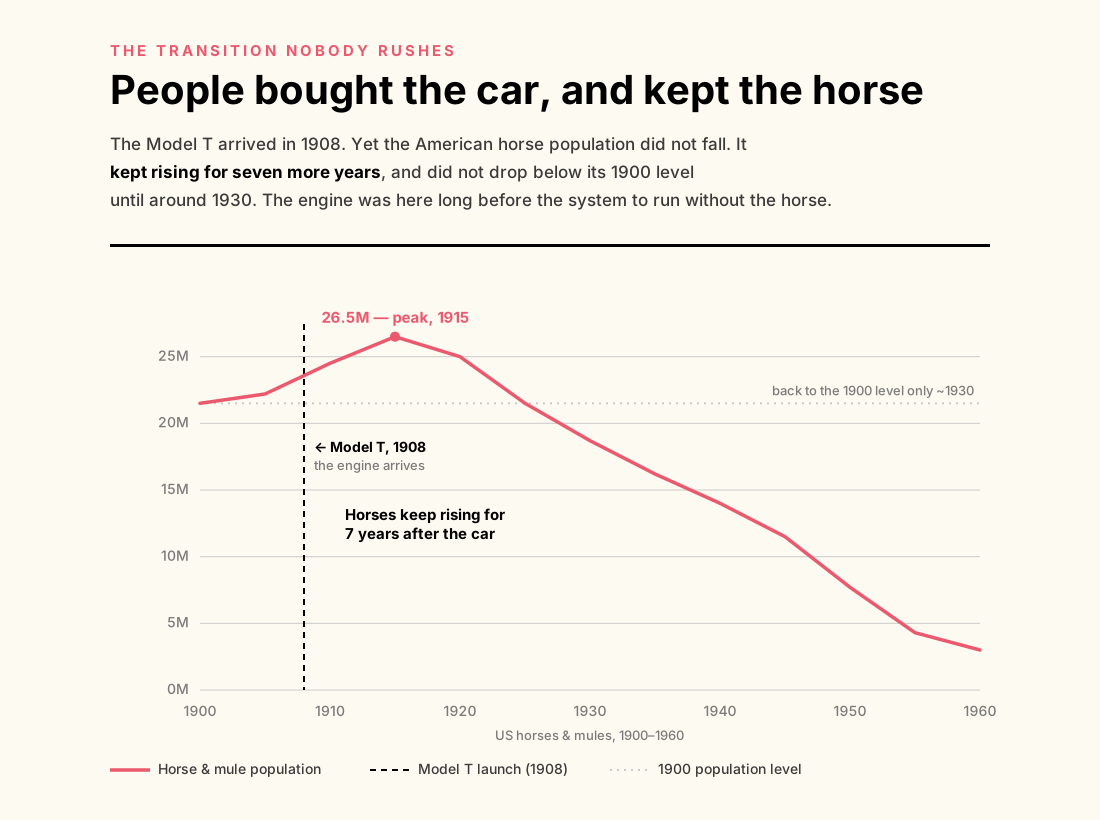
History says this is not a brief, transitional state. It is the default state and it lasts. When the car arrived the horse did not leave. The US horse population was about 21.5 million in 1900, and instead of falling once the Model T arrived in 1908 it kept climbing, peaking at 26.5 million in 1915 — seven years after the affordable car arrived. Cars did not overtake horses on the road until the 1920s and the horse population did not fall back to its 1900 level until 1930.16
What happened to the work?
The natural anxiety agentic AI automation of intellectual (and in time physical) labour brings is: what about the jobs? The car offers a strong parallel: it's neither the optimist's nor the pessimist's version.
The displaced trades did die. The horse economy was vast: farriers, blacksmiths, coachmen and many more, including those who cleaned manure from streets. Much of that world was gone by the 1930s. It was not painless: the collapse in demand for horse feed helped drive an agricultural depression in the 1920s; in 1933 the Census Bureau named the horse to car transition one of the main contributing factors in the economic crisis.17 Some blacksmiths became the first car mechanics. Many did not.
However, the system that replaced the horse employed far more people than the horse ever had. By 1929, the automobile industry accounted for nearly 13 percent of the value of all US manufactured goods. Counting everything downstream, the car industry employed roughly 7 percent of all American workers and paid 9 percent of all wages. Whole cities were built on it — Detroit went from 285,000 people in 1900 to 1.5 million by 1930.18
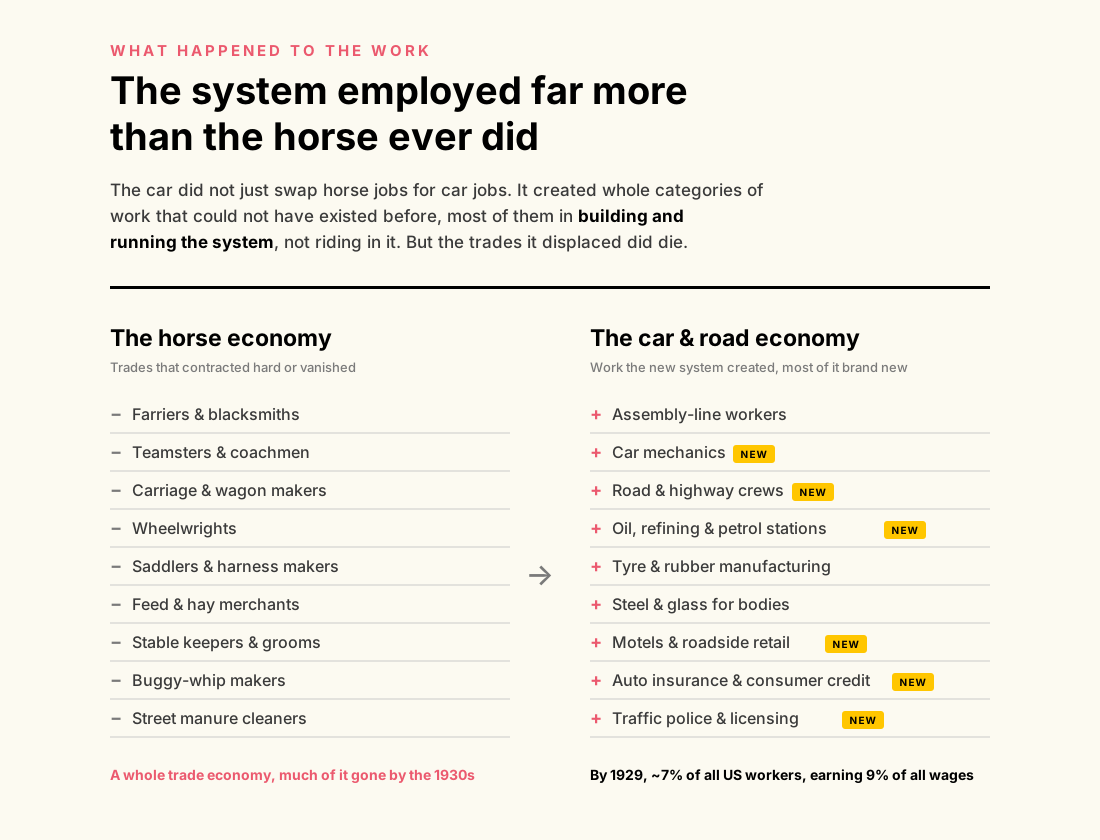
The lesson transfers with uncomfortable directness. As intellectual labour is displaced by agentic AI, the employment it generates will not come from people using agents. It will come from the vast, unglamorous work of building the roads the agents run on — the data capture and engineering, the integration, the governance, the monitoring, the verification. The motorway ultimately resulted in more employment than the car.
We see this happening. Leading software engineers no longer write code directly, their role is to manage the code writing factory populated with agents. The harnesses, the specifications, the quality checks, the infrastructure, the use cases. In some roles, the option to move up the value chain and manage the factory is not there; copy-editing is likely to go the way of the coachman. These impacts haven't yet shown up in population-level statistics. As the unit cost of software has fallen, demand has risen sharply (as has been the case since software began) — Jevons' paradox in action.19
There is still space for craft in this new world, and I think there will be for a long time. The jobs discussion above can read as deterministic — and parts of it are — but the creative act itself doesn't get road-built away. What is worth doing, how to frame it, what to build and why, is still a human act. This essay is an example. AI let me write faster and research more than I would otherwise have managed, but I still drove the car. The metaphor, the framing, the things I think are worth saying — those are mine.
What lessons can I apply to design the agentic organisation?
Cars as a technology, over a century, produced a whole apparatus for running machines at scale safely. Each part of that apparatus is a template an organisation can borrow. Seven are worth naming.
1. Move humans from inline gate to exception handler
For the car, this was from the red flag walked ahead of it, to the traffic light, to the speed camera. The red flag made the system safe and useless at once. The traffic light is automated, but it still stops everyone — that's where most organisations land when they replace human gates with automated ones. The mature endpoint for agentic enabled workflows is the camera: a human who sets tolerances, audits a sample and investigates flagged anomalies. A reviewer who reads 100% of an agent's output is a red flag man. The work of transformation is to build the camera. This single shift is the most consequential one on the list, because inline review is where most agent value is lost today.
2. License the operator and the use case, not the technology alone
The road system does two things, and it pays to keep them separate. First, it sets a floor the vehicle must clear: type approval, the MOT, basic roadworthiness, so that nothing on the road is a death trap. Second, it licenses the driver, and matches the licence to the vehicle. An HGV and a hatchback need different ones.
Agents need both layers. The floor is real and worth building: model evaluations, safety testing, baseline guard-rails. But a floor is not a system. Most organisations stop there. They ask only whether the AI is safe to use, and then either license no operators at all or swing the other way, putting a human reviewer on every AI journey no matter who is driving or why.
The sharper question is about the driver and the trip, not the engine: who can run this agent unsupervised, and for what kind of work? A junior on a customer-facing task and a senior engineer on an internal data tool should not hold the same licence. One blanket AI policy pretends they do.
3. Insure the residual risk rather than wait for zero risk
The car never became risk free. Society stopped trying to eliminate accidents and instead built a system to price, pool and absorb them: compulsory motor insurance. Organisations that are waiting for AI agents to be error free before deploying will wait forever. The mature question is per process: what is the acceptable error rate here, what does the error cost, and how do we absorb it?
4. Investigate incidents; don't close the road
When a car crashes, the road network does not shut down. The incident is investigated, and if it exposes a systemic flaw (a defective part or road) the class of problem is fixed.
5. Make the agent's environment legible
A motorway works because it's designed to be read. The driver is not asked to intuit everything and is trained and certified for their competence in following the highway code. For an agent, clear data schemas, context, instructions and explicit interfaces are key. Today, unreliable agents may be the result of unmarked roads.
6. Humans and agents need a shared highway code
Speed became safe at scale once every road user shared a common framework even though the rules within it differed by road. Motorway, urban street and school zone all sit under the same Highway Code, but each has its own expectations. Governing the agents is not enough; the people around them need the same kind of shared framework. The specific norms can differ by department or use case. Verification in a legal team won't look like verification in marketing. The underlying code of how to hand work to an agent, how to verify it and how to escalate should be one thing everyone recognises.
7. Focus on setting the destination, not the route
The road system let people go where they wanted, faster. It never decided where anyone should go. That choice stayed with the traveller, and it was the one thing road-building couldn't touch.
Agents split the same way. The human sets the destination: what to aim at, what counts as done, what's out of bounds. The agent covers the distance. Yet most organisations still spend their scarce human attention on the route, checking lines of code, redrafting documents, reading email by email, when the leverage is upstream, in choosing where to go at all.
Two limits of the analogy are worth admitting. Roads were shared public goods built by states. Organisational roads are private and idiosyncratic — each organisation builds its own and can't free-ride on a national programme, so the gap between the solo operator and the organisation is likely to be persistent rather than transitional. And the car's capability was fixed once it was bought; agent capability is still climbing. A road optimised for today's agents may not suit next year's. This favours flexible roads — better data, clearer interfaces, clearer decision rights — over rigid ones like brittle automated pipelines.
Many of these lessons have already been adopted in manufacturing. Perhaps most famously with lean six sigma as a statistical management philosophy addressing many of the above points. Knowledge work is undergoing its own industrialisation, from a craft based system of implicit knowledge, credentials and apprenticeships to industrial automation. Many startups are building these factories of the mind, and the most progressive large organisations have realised the need to change.
Speed is a property of the system, not the engine. The individual already has agent speed. The organisation that only buys engines and skips the roadworks will keep wondering why its very fast cars are moving at the speed of a horse.
With thanks to Andy Phelps and Gard Jenset, whose input sharpened this essay.
Footnotes
-
Germany's Cologne–Bonn road (now Bundesautobahn 555) opened on 6 August 1932 as the first crossroads-free public road built exclusively for motor vehicles, with horse-drawn vehicles, pedestrians and cyclists excluded by design. Britain's M1, the first inter-urban motorway, opened on 2 November 1959. See Bundesautobahn 555 — Wikipedia and M1 motorway — Wikipedia. ↩
-
The 1899 record was set on 29 April 1899 at Achères, near Paris, by Camille Jenatzy in the electric La Jamais Contente, at 105.88 km/h (65.79 mph) — the first road vehicle to exceed 100 km/h. The 1910 record was Barney Oldfield's run of 131.7 mph on Daytona Beach in the Blitzen Benz; an enhanced run in 1911 reached 141.7 mph. See La Jamais Contente — Wikipedia and Blitzen Benz — Wikipedia. ↩
-
The 20 mph limit was set by the Motor Car Act 1903 and abolished from 1 January 1931 by the Road Traffic Act 1930. The "brought the law into contempt" line is Lord Buckmaster's, recorded in the Hansard debates around the 1930 Act; see also Road speed limits in the United Kingdom — Wikipedia. ↩
-
Brooklands was built in nine months by ~1,500 workmen on private land at Weybridge, opening on 17 June 1907 — the world's first purpose-built banked motor-racing circuit, funded by Hugh Locke King after Britain's 20 mph public-road limit made high-speed testing impossible. See Brooklands — Wikipedia, the Brooklands Museum timeline and Historic England's "10 Winning Facts about Brooklands". ↩
-
The Cologne–Bonn Kraftfahrstraße opened in 1932; the M1 in 1959; the US Interstate system was authorised by the Federal-Aid Highway Act of 1956. The autobahn-ahead-of-demand point is well documented: the A 555 was funded partly as a public-works employment scheme in the depression years before German car ownership justified the road on traffic grounds — see Bundesautobahn 555 — Wikipedia and "How German Autobahns changed the world" — CNN Travel. ↩ ↩2
-
The general-purpose-technology framing — steam, electricity, semiconductors as cross-economy enabling engines with strong complementarities — was formalised by Bresnahan and Trajtenberg, "General Purpose Technologies: Engines of Growth?" NBER Working Paper No. 4148 (1992). For the productivity-decreases-before-it-rises pattern, see Paul A. David, "The Dynamo and the Computer: An Historical Perspective on the Modern Productivity Paradox" (1990). ↩
-
This is Paul David's central case: factories kept the centralised driveshaft architecture inherited from steam and just swapped the prime mover, so electric-motor diffusion exceeded 50% only in the 1920s and the layout-redesign productivity gains came roughly forty years after electrification began. See David, "The Dynamo and the Computer". ↩
-
MIT's NANDA initiative reported in 2025 that ~95% of enterprise generative-AI pilots delivered no measurable P&L impact, identifying the gap as organisational rather than technological. See "MIT report: 95% of generative AI pilots at companies are failing" — Fortune. On the productivity-erosion mechanism, see "AI-Generated 'Workslop' Is Destroying Productivity" — Harvard Business Review, Sept 2025. ↩
-
Horses remained essential in the First World War because early motor vehicles and tanks were mechanically unreliable and coped less well with mud and rough ground; the inter-war expansion of motor manufacturing then sharply reduced military horse use by the Second World War. See "Horses in World War I" — Wikipedia. The maturation was uneven — even in 1939–45 the German army still relied heavily on horses — which is itself part of the point about how unevenly a technology matures and diffuses. ↩
-
arXiv announced in May 2026 that it will impose a one-year submission ban on authors who submit papers containing obvious signs of unchecked AI generation (e.g. hallucinated references or stray AI meta-comments). See "Research repository ArXiv will ban authors for a year if they let AI do all the work" — TechCrunch. ↩
-
LinkedIn application volumes and the +45% YoY increase are reported in eWeek, "Job Seekers — Some Using AI — Flood LinkedIn With 11,000 Applications a Minute". The 65% deceptive-AI-use figure and the Greenhouse CEO "authenticity crisis" quote are from Fortune, "Hiring platform CEO says talent acquisition is in an 'AI doom loop'" (November 2025). ↩
-
Cross-court survey and the 1,500+ tracked cases: Sterne Kessler, "AI Hallucinations in Court Filings and Orders: A 2025 Review of Sanctions Across the Courts" and the AI Hallucination Cases Database (Damien Charlotin). The Sixth Circuit sanctions ruling is summarised in the Sixth Circuit Appellate Blog; a wider write-up is Scientific American, "Why Lawyers Keep Citing Fake Cases Invented by AI". ↩
-
Detection rates and the arms-race framing are from "AI Cheating in Schools: 2025 Global Trends & Bias Risks"; the academic case against detection as a strategy is made in "End the AI Detection Arms Race" (NCBI). The shift toward oral exams and supervised assessment is documented across institutional responses summarised in the same survey. ↩
-
Google's June 2025 "scaled content abuse" manual actions and their effect on affected sites: "Google vs. AI Content: Winning Strategies for 2025" and "Does Google Penalize AI Content? New SEO Case Study (2025)". ↩
-
Post-war American aid to Greece included the "Animals for Greece" campaign (the Greek War Relief Association, with US Department of Agriculture support) and Marshall Plan livestock shipments — thousands of mules, donkeys, horses and cattle sent to rebuild Greek farms on terrain where draft animals out-performed tractors. See "When the American People Sent 15,000 Animals to Revitalize the Greek Countryside" — The Pappas Post and "Greece and the Marshall Plan" — The George C. Marshall Foundation. ↩
-
US horse-and-mule population was ~21.5 million in 1900, peaked at ~26.5 million in 1915 — seven years after the Model T launched in 1908 — and only fell back below the 1900 level around 1930. Series compiled in Emily R. Kilby, "The Demographics of the U.S. Equine Population" (adapted from Ensminger, 1969); summarised by Yale Energy History, "Horse and Mule Population Statistics". ↩
-
The 1933 Bureau of the Census judgement is quoted in Brad Smith, "The Day the Horse Lost Its Job" — the Bureau concluded the horse-to-car transition was "one of the main contributing factors of the present economic situation" and had "affected the entire country," via the collapse in feed demand on already-weak farm incomes. ↩
-
The 1929 share-of-manufactured-goods, share-of-workers and share-of-wages figures are from "A New Era, 1920–1929" — Who Built America?. Detroit's population went from ~285,700 in 1900 to ~1,568,662 in 1930; see Demographic history of Detroit — Wikipedia. ↩
-
Jevons' paradox: efficiency gains in the use of a resource can raise, not lower, its total consumption — first articulated by W. S. Jevons in The Coal Question (1865) observing coal consumption rising after Watt's more efficient steam engine. See Jevons paradox — Wikipedia. ↩